


Finding clear facts about 3-FA isn’t easy. Online threads tell different stories about what it does, how much to take, and whether it’s legal. This guide makes things clear using reliable sources, and the best available research. It makes a clear distinction between what people report and what’s truly confirmed, making it practical for anyone researching this compound.
Effects, Dosage, Duration, Legality
Here are the important details.
What 3-FA Feels Like
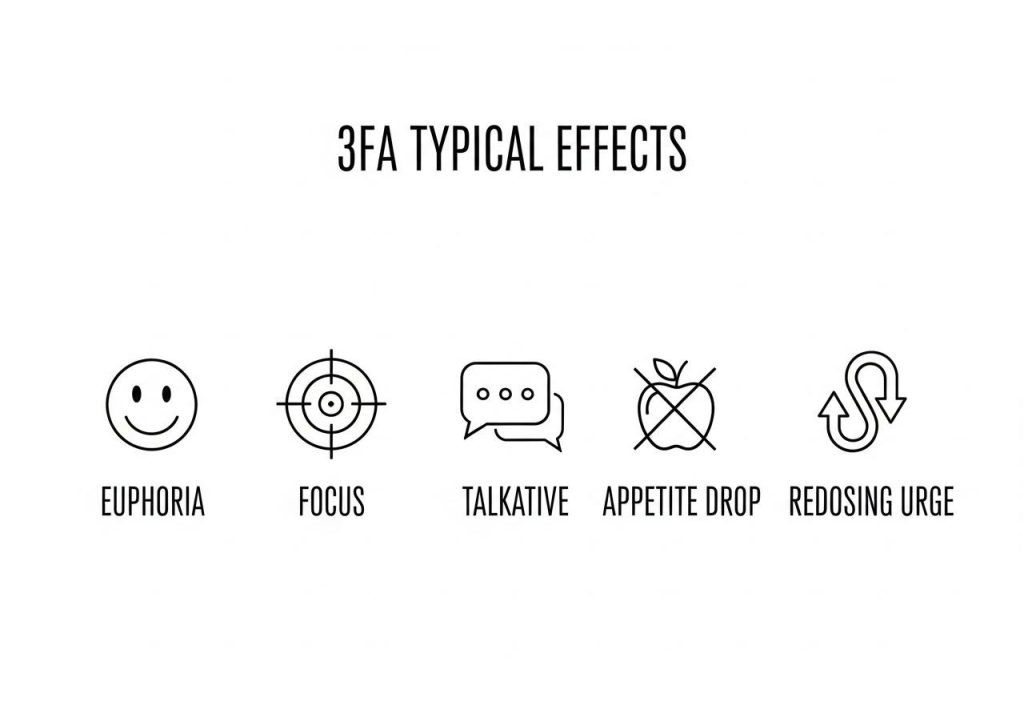
- Euphoria and stimulation: Most say it lifts their mood and gives a burst of mental and physical energy.
- Focus and motivation: Task-focused, driven moods are common.
- Talkativeness and sociability: Many feel more outgoing and chatty.
- Lower appetite, trouble sleeping: These usual stimulant effects occur, making it hard to eat or rest.
- Anxiety shifts: Anxiety often drops during the peak, then rebounds as the effects fade.
- Urge to re-dose: As the effect wears off, there’s a strong desire to take more.
Dosage & Duration
Here is an overview of what people usually take by mouth. Caution: Potency varies between batches. Always go low to start.
| Dosage Level | Oral Range (User-Reported) |
| Threshold | 5–10 mg |
| Light | 10–15 mg |
| Common | 15–30 mg |
| Strong | 30–60 mg |
Duration: Most people experience effects for 4–6 hours, but this can change depending on the person.
Legal Status
- USA: Not named on federal lists, but the Federal Analogue Act covers it if used for getting high. Some states, like Alabama, Nevada, and West Virginia, ban it.
- UK: 3-FA is a Class A drug. Illegal to possess, buy, or sell it.
- Germany: Banned under the NpSG (New Psychoactive Substances Act). Trade and delivery carry penalties.
What is 3-FA (3-Fluoroamphetamine)?
3-FA is a synthetic stimulant from the amphetamine family. It belongs with other fluorinated amphetamines like 2-FMA and 4-FA. It’s sold mostly for research and isn’t approved for medicine or recreation.
Names, Codes, and Structure
| Identifier | Value |
| Full Name | 3‑Fluoroamphetamine (3‑FA) |
| IUPAC | 1-(3-fluorophenyl)propan-2-amine |
| CAS | 1716-59-2 |
| Formula / MW | C9H12FN / 153.20 g/mol |
| Class | Substituted Amphetamine |
How It Stands Out
3-FA is often talked about in the same way as regular amphetamine due to its energetic, motivating feel.
- Most describe it as more “functional” rather than giving the pleasant emotional feelings of MDMA.
- People describe fewer “serotonin” effects than with 4-FA.
- Experiences depend on dose, mindset, surroundings, and purity.
How It Works
3-FA boosts dopamine and norepinephrine in your brain.
It works by helping these brain chemicals release, leading to a sense of energy, sharper focus, and fewer hunger or sleep signals. Its effect on serotonin isn’t as strong. That’s why it’s described as a straightforward stimulant.
So, after taking it, you feel alert, awake, and can’t sleep or eat much.
3-FA Effects: What Happens and the Comedown
This section covers the main things users experience, both during and after.
During the Experience: Mental Effects
- Increase in energy, alertness, and motivation
- Heightened thoughts and analytical focus
- High spirits and more confidence
- Extra talkative and social
- Sometimes music sounds enhanced with higher doses
- Anxiety drops for some, but not for everyone
During the Experience: Body Effects
- Fast heart rate, sometimes pounding in your chest
- More sweating, dry mouth, can get dehydrated
- Appetite decreases significantly
- Jaw tension and teeth grinding (often lighter than other stims)
The Next Day
Once it fades:
- Cannot sleep or have restless nights
- Feel irritable, numb, or in a low mood
- Anxiety can return, sometimes hard
- Heavy mental fatigue or fog
- Temptation to take more to avoid the low
Dosage Advice for Research Use
This info is for reducing risk and for research, not for self-medication. Potency isn’t reliable. Don’t use this as personal dosing advice.
Oral Dosage Ranges
| Dosage Level | Oral Range (User-Reported) |
| Threshold | 5–10 mg |
| Light | 10–15 mg |
| Common | 15–30 mg |
| Strong | 30–60 mg |
Dosing Methods
- Clear information about routes like snorting or oral use isn’t widely available.
- The usual duration (4–6 hours) doesn’t change much by route.
- Snorting can make the effects start faster and harder, but also heightens risks of overuse and side effects.
Signs You’ve Taken Too Much
If any of these happen, seek emergency help:
- Chest pain, fainting, severe headache, or trouble breathing.
- Confusion, uncontrollable panic, or seeing things that aren’t there.
- Overheating, feeling dangerously hot, or not sweating anymore.
- Heart beating irregularly.
- Seizures.
Safety: Risks, Precautions, Interactions
3-FA is still being studied. Since we don’t know enough, caution is key.
Known Risks
- Unknown long-term risk: No real studies on effects from regular use.
- Heart strain: Like all stimulants, it stresses the heart and can raise blood pressure.
- Worsening anxiety/panic: Especially with little sleep or after big doses.
- Redosing: Strong urge, and repeated use can make the comedown worse.
- Dehydration/overheating: Be careful, especially if active or in warm environments.
Combinations to Avoid
- NEVER mix with MAOIs. Blood pressure can rise rapidly and dangerously.
- Don’t mix with other stimulants. This includes amphetamines, cocaine, cathinones, and big caffeine doses. Risks increase.
- Don’t mix with alcohol. Being drunk and stimulated, it’s easy to overdo and miss warning signs.
- Be careful with SSRIs/SNRIs. Interactions aren’t well understood and can get unpredictable.
Health Conditions
If you have heart issues, high blood pressure, anxiety, or a history of psychosis, the risks are higher. Not safe if pregnant or breastfeeding. For health questions, talk to a doctor.
Basic Safety Tips
- Go low on the dose, especially with something new.
- Track your water, food, and timing. Use reminders if needed.
- Rest well before and after.
- Avoid using alone, especially if you’re new.
- Test the compound with reagents, if possible.
Legal Status of 3-FA in 2026
Law is complicated and changes often. Always check recent rules in your area.
United States
3-FA isn’t named on federal lists, but Federal Analogue Act rules can apply if it’s for human consumption, not research. This makes the legal status unclear.
Federal Penalties: Under the Analogue Act, punishments for possession, selling, or making can match those for Schedule I drugs like heroin. First offense? Can be up to 20 years and fines up to $1,000,000.
States With Clear Bans
- Alabama: Schedule I.
- Punishment: Possession: 1–10 years, up to $15,000 fine. Selling: 2–20 years, up to $30,000 fine.
- Nevada: Schedule I for fluoroamphetamine.
- Punishment: Possession: 1–4 years, up to $5,000 fine. Selling: 1–6 years, up to $10,000.
- West Virginia: Named as controlled.
- Punishment: Possession: Up to 6 months jail, $1,000 fine. Selling: 1–15 years, $25,000 fine.
United Kingdom
It’s simple: 3-FA is a Class A drug. Covered by rules outlawing amphetamine relatives. Possessing, making, or supplying is illegal.
- Punishments: Possession: Up to 7 years jail/unlimited fine. Supplying: Life imprisonment and/or unlimited fine.
Germany
Controlled under the NpSG since late 2016. Making, selling, or trading it is against the law.
- Punishments: Simple violations: Up to 3 years jail or a fine. Serious cases (large trades or harm): 1–10 years.
Countries With Unclear Laws
Information on 3-FA’s legal status for places like Canada, Australia, the Netherlands, and Sweden is limited. Don’t assume, check your current laws.
Buying, Quality, and Research Use Only
If you’re sourcing any research chemical, keep it safe and legal.
Before Ordering, Check:
- Know the law locally and where it’ll ship.
- Age rules: Legitimate sellers usually require 18 or 21+.
- Labeling: “Research purposes only,” “Not for human consumption” should be clear.
- Shipping: Discreet shipping and privacy policy are positive signs.
- Independent lab testing adds a safety layer, but isn’t always available.
If you’re in a lab, use proper, labeled sources. If researching, make sure the compound is for research only. For example, you can Buy 3fa from sites that stress this, following ethical and legal standards.
FAQ
What is the 3-FA drug?
3-FA is a lab-made stimulant from the amphetamine group, sold for research, not approved for treatment.
What does 3FA stand for?
It’s short for 3-Fluoroamphetamine.
What does FA mean in drugs?
“FA” means Fluoroamphetamine, essentially, amphetamine with fluorine attached. The “3” indicates where the fluorine is placed on the molecule.
What is a 3C drug?
This is a different category. “3C” drugs have a three-carbon side chain and are phenethylamines, not the same as 3-FA.
Is 3-FA the same as 2-FMA, 3-FMA, or 4-FA?
No. They’re all in the same chemical family but aren’t identical. The position where fluorine attaches changes their effects and risks.
How long does 3-FA last?
Most report it lasts 4 to 6 hours. Dose, tolerance, and body chemistry can change this.
Are there specific long-term health effects of 3-FA, including potential organ damage or neurological impacts?
We don’t know. No detailed human studies exist. Some amphetamines damage the brain and heart in animal studies, but clear info for 3-FA in people isn’t available yet.
Does 3-FA show up on drug tests, and what are its metabolites?
Possibly. Many amphetamine tests detect related compounds. Only advanced lab tests can identify the exact drug. In rats, it clears the system quickly, within a day or two. Human data is missing.
Metabolites: Preclinical research suggests oxidation at the 4-position, making 3-fluoro-4-hydroxyamphetamine, but more human-specific info is needed.
What are the specific quantitative data, such as half-life, peak plasma concentration, and precise receptor binding profiles, of 3-FA’s action on dopamine and norepinephrine transporters?
- Half-life and Peak (Animals):
- IV (rat): Plasma half-life is about 1–2.3 hours, C0/Cmax after a 5 mg/kg IV dose is around 924–1,412 ng/mL.
- Transdermal (rat): Cmax about 312 ng/mL, Tmax 1.5 hours, with about 32% absorbed through the skin.
- There’s no reliable human data.
- Receptor Effects:
- 3-FA boosts dopamine and norepinephrine by blocking their reuptake and pushing them out of cells. Its effect on serotonin is much weaker.
- It also acts on VMAT2 and may block some MAO activity, but binding strength at each site still lacks human numbers.
What are the recommended medical protocols for someone experiencing severe adverse effects from 3-FA?
For severe symptoms, high blood pressure, chest pain, extreme excitement, seizures, or very high fever, call emergency services.
- High blood pressure: Don’t try to lower it fast. In a hospital, IV drugs are used.
- Agitation or panic: Provide a quiet space, monitor breathing and heart rate. In hospitals, doctors might use benzodiazepines.
- Seizures: Don’t restrain the person or put anything in their mouth. Clear the area, cushion their head, and note how long it lasts. After a seizure, if they’re breathing but unconscious, roll them on their side and monitor.
- Overall: Make sure their airway and breathing are clear. Hospital monitoring is best for anything severe or if you’re uncertain.
Is 3-FA addictive?
It can be. People report wanting to keep taking more. There’s limited formal info, but the risk is similar to other stimulants.
What’s the comedown like?
Hard. Trouble sleeping, high anxiety, low mood, brain fog, and irritability are common. The worse the dose or longer the use, the more difficult the next day.
Key Points
- Effects: Functional stimulant, mostly about focus and motivation, but often followed by a tough comedown.
- Dosage: Oral use generally falls between 5 mg and 60+ mg, but batches are unreliable.
- Duration: Stimulant effects last 4–6 hours, no matter how you take it.
- Safety: Not enough data. Assume same risks as other stimulants, watch your heart and mind.
- Legality: Laws vary significantly. It’s banned outright in the UK and Germany, and in many US states, but may be a gray area federally.
The information provided in Express Highs Blog is intended for educational, informational, and harm-reduction purposes only. The content published on this page does not encourage, promote, or condone the use, purchase, sale, or distribution of any controlled or psychoactive substances.
Many compounds discussed on this website may be regulated or prohibited in certain countries or jurisdictions. Laws and regulations change frequently, and it is the responsibility of each reader to understand and comply with the local laws applicable in their location before engaging with any substance mentioned.
Articles published in this category may reference scientific research, anecdotal experiences, historical context, or emerging trends. However, the content should not be interpreted as medical advice, legal advice, or professional guidance of any kind. Always consult a qualified medical professional before making decisions that could impact your physical or mental health.


