

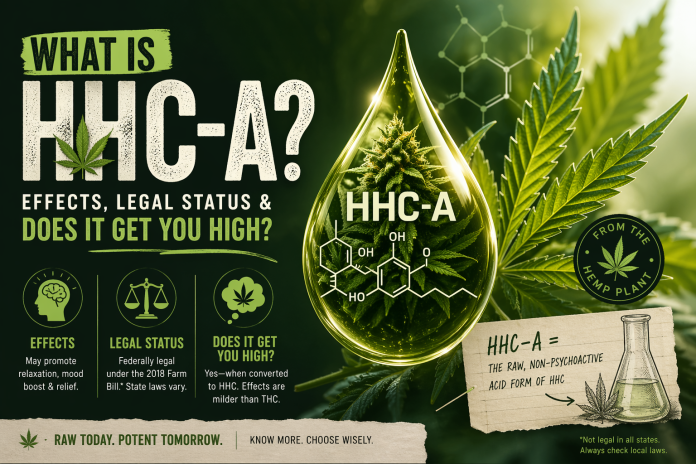
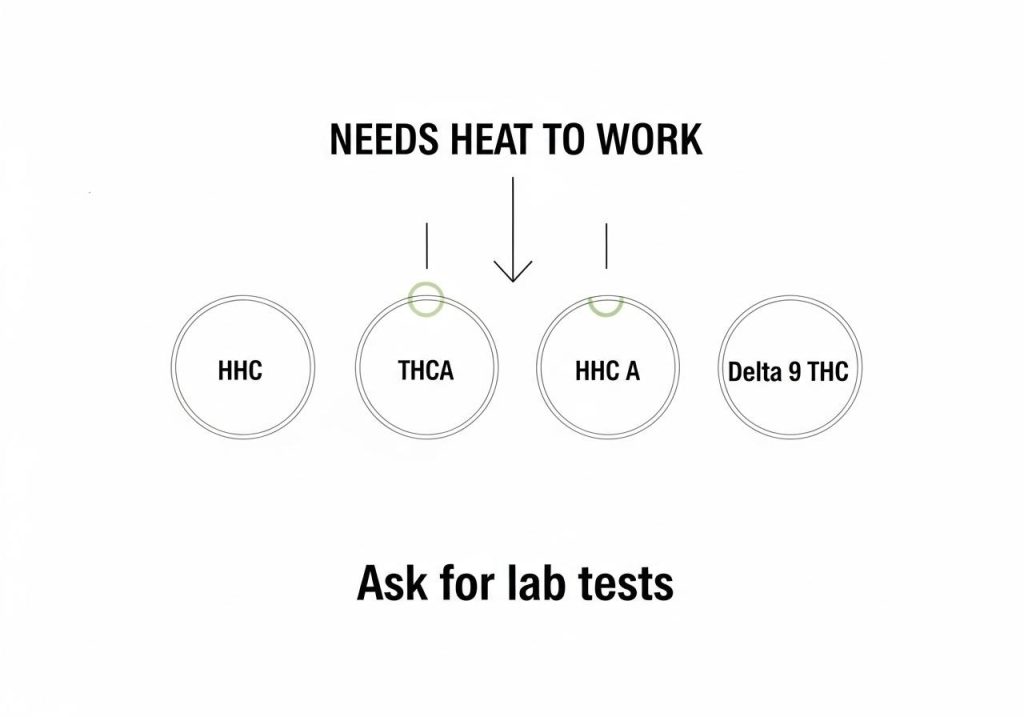
Most people curious about “HHC-A” want straightforward answers. Does it get you high? Is it legal and safe? Honestly, HHC-A isn’t well-defined, and there’s not much solid info on it. A lot of products mix up HHC, “HHC-A,” and other similar compounds. Here’s the basic point: if it’s an “acid” cannabinoid (like THCA), heat is needed to feel effects. If it’s already active (like HHC), it can get you high without heat. Always check lab results before trying anything.
Does HHC-A Get You High?
No one really knows for sure. If HHC-A is an acid form, you probably won’t feel anything unless you smoke or vape it. But if a so-called “HHC-A” edible gets you high, it’s likely just HHC. The naming in the market is all over the place, so your experience depends on what’s actually inside. Start small, don’t mix with other substances, and skip it entirely if you’ve got anxiety or a history of psychosis.
HHC-A vs HHC vs THC vs THCA
Here’s a simple breakdown:
| Compound | Intoxicating Without Heat? | Strength vs. Delta-9 THC | Typical Feel | Notes |
| HHC | Yes | Mild–Moderate (~70–80%) | Smoother, clearer head high | Most products labeled “HHC-A” are probably just HHC. |
| Delta-9 THC | Yes | The Strongest (Baseline) | Intense high, mind and body | What you expect from regular weed. |
| THCA | No | Turns into THC when heated | N/A (raw) | Not active until you add heat. |
| HHC-A | Unknown/Unlikely | Unknown, likely needs heat | Unknown | Acid form of HHC, not much info available. |
What HHC-A Actually Is (and Why It’s Confusing)
The main problem with HHC-A is that nobody agrees on what it actually is. You’ll see the name used as its own cannabinoid, but compared to THC or HHC, there’s hardly any useful info.
Generally, the “A” stands for “acid form” (like THCA). But HHC-A isn’t a well-studied or standard compound. Chemically, HHC-A sometimes means an acetylated version of HHC. That’s where the confusion starts.
Expected Effects (If It’s Really Just HHC)
If your HHC-A product is actually HHC, this is what people usually report:
- Relaxed body
- Mild head buzz
- Calmer mood
- Time seems to move differently
- Dry mouth, red eyes
- Increased hunger
- Slower reactions
- Sleepiness
- Some anxiety or paranoia (especially in sensitive people)
HHC effects often last about 2–4 hours. That’s a little shorter than Delta-9 THC, which might last 4–6 hours. Most think HHC is about 70–80% as strong as Delta-9 THC.
What Changes the “High”
Your experience can shift depending on a few things:
- Heat: Smoking or vaping hits harder and faster. Acid forms need heat to work.
- Type of Product: Edibles take longer, last longer, and you can easily take too much.
- Dose: A small increase can make a big difference.
- You: How used to it you are, your mindset, and where you are matters.
Safety: What People Overlook
The biggest problem? Not usually the cannabinoid itself, but what’s left over from making it. Byproducts from poor manufacturing are the main concern.
Contaminants to Watch For
Look for more on a vape or oil label than just “how strong it is.”
- Heavy metals like palladium, platinum, nickel
- Leftover solvents: hexane, heptane, pentane, methanol, methylene chloride
- Unknown extras from chemical steps, especially if acetylation is used
- Cheap hardware for vape carts
- Fake strength claims
- No Certificate of Analysis (COA)? That’s a no.
Possible Side Effects (If You Take Too Much)
Taking too much can get rough:
- Confusion or shaking
- Racing heartbeat, nausea
- Intense anxiety or paranoia, especially if you’re prone to it
- Rarely, serious poisoning and mental health episodes, see a doctor if things get bad
Mental Health & Addiction Risks
Watch out for mental health issues.
- Don’t use if you have psychosis or serious anxiety.
- Take breaks to avoid withdrawal symptoms.
- Don’t mix with alcohol or other drugs.
How to Check Quality Before Buying
Don’t trust flashy ads. Trust hard numbers. Here’s what to look for on a lab report (COA):
- Check the report is from a real, third-party lab and matches your product batch number.
- See that heavy metals were tested for, and numbers are there, not just “pass.”
- Check whether solvents were tested and keep limits in mind.
- Look for a full breakdown of cannabinoids and impurities.
- Skip products from brands without contact info, unclear labs, or suspicious PDFs.
| COA Checks | ||
| Must-Haves | Nice-to-Haves | Red Flags |
| Full Cannabinoid Panel (HPLC-MS/MS or UHPLC-MS/MS preferred) | Terpene Profile | No COA Available |
| Heavy Metals Test (ICP-MS) | Mycotoxin/Pesticide Screen | Missing Batch Number |
| Residual Solvents Test (GC) | Incomplete or “Potency Only” Test |
Legal Status: Is HHC-A Legal Where You Live?
This changes fast. This isn’t legal advice.
United States: Federal Status
Laws are in flux.
- In 2024, the DEA said HHC is illegal because it’s synthetic and not found in hemp.
- Some courts still allow hemp products if under the Delta-9 THC limit, so it’s messy.
- New law ahead: Signed November 12, 2025, H.R. 5371 changes the rules again, any “intoxicating cannabinoid” not found naturally is banned, and now the limit is 0.4 mg THC per container, not 0.3% by dry weight.
United States: State-by-State Reality
It depends on where you live. Laws are all over the place, so always double-check locally. For now, here are a few examples; just use them as a starting point.
(As of early 2026; check your state for updates)
| Allowed (Examples) | Restricted/Unclear (Examples) | Banned (Examples) |
| Georgia, Florida, New Jersey, Ohio | California, Texas, Missouri | New York, Washington, Idaho, Illinois |
UK/EU/Europe
Be cautious. Most countries treat anything like THC as illegal, but enforcement varies. When in doubt, treat it like THC and check the national rules.
Will HHC-A Show Up on a Drug Test?
Assume the answer is yes. HHC breaks down into substances that will trigger standard drug tests.
- Avoid HHC before a drug test.
- Don’t believe the “will not pop a test” marketing lines.
- Play it safe if you’re worried about drug screenings.
How HHC-A Compares to Delta-8, HHC, and Delta-9
Here’s a simple cheat sheet:
| Cannabinoid | Strength | Headspace | Anxiety Risk | Best For… |
| Delta-8 | Lighter | Calm, more body than head | Lower | Beginners or those wanting mild effects |
| HHC | Middle | Clear, able to function | Moderate | A step above Delta-8, less strong than THC |
| Delta-9 | Strongest | Classic, strong high | Higher | Experienced users after more intensity |
| THCA | N/A (raw) | N/A until heated | N/A | People wanting to convert with heat |
FAQs
Is HHC-A the same as HHC?
No. HHC-A is probably the acidic, non-active starting point for HHC, maybe acetylated. But in practice, most products with “HHC-A” are likely just HHC that works without heat.
What is HHC-A?
Technically, it’s hexahydrocannabinolic acid, a raw version of HHC. In reality, it’s a loosely used label, mostly in products with little regulation.
Does HHC-A need heat to work?
If it’s the acid form, yes, you need heat (decarboxylation) to turn it into active HHC. If an edible marked “HHC-A” does something, it was probably just HHC.
How strong is HHC-A?
Depends on what’s actually inside. If it’s really HHC, expect about 70–80% the strength of Delta-9 THC.
Is HHC-A a good high?
That’s personal. Most people who like HHC say it’s less stressful, more clear-headed, and easier to function with than THC. Good if you want something calmer.
What is stronger, HHC or THCA?
Hard to compare. THCA does nothing until it’s heated and becomes THC (then it’s stronger). Heated THCA is more powerful than HHC.
How long do HHC-type effects last?
Usually about 2 to 4 hours. Delta-9 THC lasts longer, up to 4–6 hours or more.
How do I spot a fake lab report?
Watch for missing batch numbers, labs without a website or phone, no test for impurities, or dates older than a year.
How to Accurately Distinguish HHC, HHC-A, and Other Cannabinoids
To know what you’re getting, you need proper lab testing.
1. Chromatography Methods:
- HPLC-MS/MS and UHPLC-MS/MS: Good for checking both active and acid forms. Helps spot the difference between HHC, HHC-A (acetylated kinds), and related compounds.
- GC-MS/MS: Fine for some tests, but not the best for acid types, they change during testing. LC-MS methods work best for keeping the compound unchanged.
2. Confirmatory Testing: You need detail. Labs use high-res mass spectrometry plus reference standards to really tell the difference between similar compounds.
3. Typical Screens: Good lab panels check for:
* Different HHC types (epimers)
* THC and THC-related compounds
* Other cannabinoids (CBD, CBN, THCA)
* Leftover solvents
* Pesticides
* Heavy metals
* Germs/mold
Specific Chemical Synthesis Pathways and Impurities of HHC-A
HHC-A is mostly made by changing HHC in the lab. Here’s how it happens and what to look out for.
1. How HHC is Made:
* Catalytic Hydrogenation: Most often, lab workers add hydrogen to Delta-9 or Delta-8 THC using metals like palladium or platinum. This makes HHC.
* Other Methods: Sometimes, they use other chemical methods to favor certain versions.
* From CBD: CBD can be turned into THC, then hydrogenated like above.
2. Making HHC-A (Acetylation/Hydroxylation):
* Acetylation: Basically, HHC gets mixed with chemicals like acetic anhydride.
* Hydroxylation: Adding an OH (hydroxyl) group before or after, depending on the method.
3. Common Byproducts:
* Catalyst Metals: Watch for leftover palladium, platinum, etc.
* Unreacted Starting Materials: Sometimes not all of it is converted; you may get bits of Delta-9, Delta-8, or CBD.
* Structural Isomers & Extras: Lots of close relatives can show up in the mixture.
* Solvent Leftovers: Hexane, methylene chloride, and other solvents must be tested for.
* Unreacted Chemicals: In acetylation, leftover acetic anhydride can stay behind.
Detailed Clinical or Toxicological Studies for HHC-A
As of early 2026, no clinical trials or long-term studies for HHC-A are available. What we have are animal tests, small surveys, or poison center reports, not the gold standard.
1. Preclinical (Animal, Lab Work):
* How it Works: HHC seems to act on the same receptors as THC and does similar things, but strength and effects can vary.
* Toxicity: At high enough doses, animals show central nervous system effects and other issues.
* How it Breaks Down: Metabolized in the liver like THC, creating similar breakdown products.
2. Human Data (So Far):
* Surveys: In one small survey, about 17% got anxious, and 20% had withdrawal-like symptoms with HHC.
* Poison Center Cases: Reports in Europe show some people had bad reactions, neurological or heart issues, after using products with HHC.
3. What’s Still Unclear:
* No Controlled Human Studies: We don’t know enough about safe dosing, long-term use, or detailed risks.
* Product Variability: Problems are made worse by inconsistent labeling and inconsistent product formulas.
Key Takeaways
- There’s still not much proof or clear info about HHC-A.
- If it’s the acid version, you need heat for it to work. If not, it’s probably just HHC.
- HHC gives a milder, clearer high than THC.
- Main risks are from contaminants, not the cannabinoid itself.
- The law is changing, now the U.S. focuses on 0.4 mg total THC per container, and most synthetic cannabinoids are banned. Check before you buy.
Disclaimer
The information provided in this article is intended for informational purposes only and does not constitute medical, legal, pharmaceutical, or professional advice of any kind. Express Highs makes no representations or warranties regarding the accuracy, completeness, or suitability of the content for any particular purpose. Readers should not rely on this content as a substitute for advice from a qualified medical professional, legal counsel, or other relevant expert.
The products and substances discussed on this blog may be subject to varying legal restrictions depending on your country, region, or jurisdiction. It is the sole responsibility of the reader to be aware of and comply with all applicable local, national, and European Union laws and regulations before purchasing, possessing, or using any product referenced herein. Express Highs accepts no liability for any consequences arising from actions taken based on the content of this article.
This blog is intended for adults only. By reading this content, you confirm that you are of legal age in your jurisdiction.
Nothing in this article is intended to diagnose, treat, cure, or prevent any disease or medical condition. Any health-related claims discussed are not evaluated by the European Food Safety Authority (EFSA) or any other regulatory body unless explicitly stated.
Express Highs reserves the right to update or remove content at any time without notice. All content is published in good faith and for general informational purposes only.


