

O-PCE is a type of dissociative drug. While people often lump it in with ketamine, it’s really its own thing with its own set of effects and dangers. This guide lays out what O-PCE is, how it’s different from other similar drugs, and what kinds of problems people run into when using it.
The info here comes from harm-reduction groups, emergency alerts, and basic summaries from pharmacology. There’s not much formal research. Most of what we know is from stories in hospital records and users’ own reports.
What is O‑PCE and why do people compare it to ketamine?
O-PCE (full name: 2-oxo-PCE or eticyclidone) is in the same chemical family as ketamine and PCP. Still, just because they look related doesn’t mean they act the same.
- Different feeling. Like ketamine, O-PCE messes with NMDA receptors in the brain, but people say it feels more jarring and stimulating.
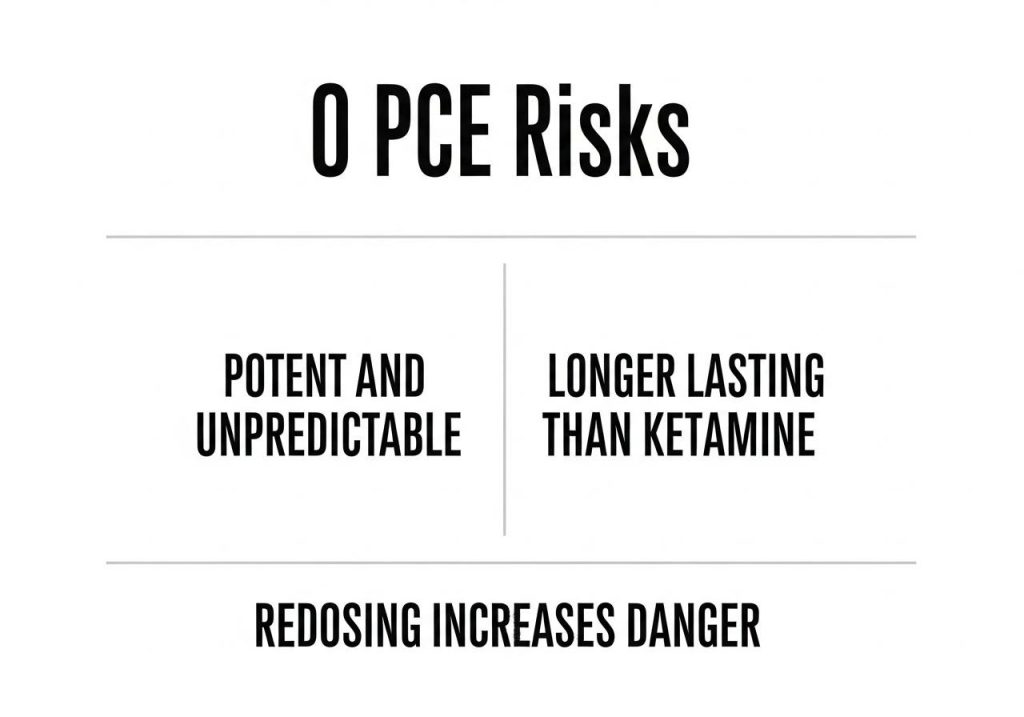
- Longer High. Ketamine lasts about an hour. O-PCE can keep you under for three to six hours, sometimes more. That’s a lot of time to get disoriented or redose by mistake.
- Very potent and often mislabeled. You need very little to feel effects. Sometimes it’s sold as “super strong ketamine” or even passed off as things like MDMA. People end up in the hospital because of that.
Key Points
- O-PCE is stronger and the effects last much longer than ketamine. Small mistakes in dosing can turn serious fast.
- It can feel both wired and knocked out, which can make it hard to predict how someone will act.
- The biggest risks: redosing because it feels slow to start, or taking the wrong thing by accident.
- Always be careful with white powders, a bad mix-up can have real consequences with O-PCE.
O‑PCE facts: names, class, and chemistry
A few basics about O-PCE.
- Names: O-PCE, 2-oxo-PCE, Eticyclidone
- Drug family: Arylcyclohexylamines (same group as ketamine, PCP)
| Attribute | Details |
| Molecular Formula | C₁₄H₁₉NO (free base) |
| Molecular Weight | 217.31 g·mol⁻¹ (free base) / 253.8 g·mol⁻¹ (hydrochloride salt) |
| Typical Form | White or off-white powder (hydrochloride salt) |
| Market Status | Sold online as a “research chemical.” Legal status is muddy, with little regulation or quality checks. |
How O‑PCE works
O-PCE blocks a certain kind of brain signal (NMDA receptors). These are like doorkeepers for the messenger glutamate, helping brain cells talk to each other. When O-PCE shuts those doors, messages get scrambled. This is what makes people feel disconnected from themselves and the world.
Different things affect how you feel it: dose, how pure it is, your tolerance, how you take it, and what else you’ve taken. There’s little research in humans. Most of what’s known is based on emergency cases and stories from people who’ve used it.
What O‑PCE feels like: reported effects
People report a mix of mental and physical changes.
Mental and sensory
- Dissociation: You might feel cut off from your body, your thoughts, or reality in general.
- Odd sense of time: Time might drag or fly by. Sometimes it almost stops.
- Confusion: Making decisions, concentrating, or thinking straight can be tough.
- Dreamlike experiences or hallucinations: High doses may bring vivid, sometimes unsettling visions.
Physical
- Loss of coordination: Walking or even sitting upright gets tricky.
- Nausea: You might throw up, especially as it’s starting.
- Heart racing: Many feel their heart beat faster, sometimes uncomfortably so.
- Sedation: At times, it weighs you down so much that moving or talking is out of the question.
If what you’re feeling is different than expected, stop and don’t take more. With a strong, long-lasting drug like O-PCE, it’s not worth the risk.
Onset and duration: why O‑PCE often catches people off guard
Timing is an issue. People used to fast-acting drugs fall into a trap, they think it’s not working and redose, or they forget how long they’ll be affected.
- Starts slow: It can take 20 to 40 minutes to really kick in. Some get impatient and take more before it’s even started.
- Stays around: The main effects can last 3–6 hours. Even then, you might feel lingering effects for much longer.
| Substance | Onset (min) | Duration (hrs) | What to expect |
| O‑PCE | 20–40 | 3–6+ | Very strong, can be more disorienting and stimulating than ketamine. Effects trail off slowly. |
| Ketamine | 5–20 | 0.5–1 | Short, predictable. Acts as the standard for comparison. |
| 3‑HO‑PCP | 20–90 | 3–4 | Strong, starts slow, risk for taking too much is high. |
A long-lasting drug is more likely to lead to accidents, confusion, risky decisions, or bad reactions to other substances.
Major risks people underestimate
Here’s how things usually go wrong.
- Underestimating potency. Small amounts hit hard and last long, so eyeballing a dose is playing with fire.
- Redosing before it kicks in. People think nothing’s happening, so they take more, then suddenly it’s way too much.
- Coordination loss. Trips and falls are real possibilities. Some wander into danger or can’t help themselves in an emergency.
- Panic, paranoia, or even psychosis. Strong, drawn-out dissociation can spin into scary mental states, especially if you haven’t slept.
- Blacking out. Sometimes, people pass out or become unresponsive. If mixed with booze or certain meds, breathing can slow down dangerously.
When to Get Help
- If someone can’t be woken up
- If breathing slows or becomes irregular
- If vomiting keeps happening
- If there’s chest pain or a seizure
- If someone is extremely agitated, confused, or paranoid
Mixing O‑PCE with other drugs: what goes wrong
Mixing drugs makes things riskier. Many O-PCE emergencies happen because of combos, not the drug by itself.
| Combination | Why it’s risky |
| Depressants (Alcohol, Benzos, Opioids, GHB) | Greatly increases chance of passing out, breathing slowing down, and overdose. This mix is particularly dangerous. |
| Stimulants (Cocaine, Amphetamines) | Raises risk for panic, rapid heartbeat, and out-of-control behavior. Both drugs clash, making things confusing and scary. |
| Other Dissociatives (Ketamine, DXM, PCP types) | Total confusion possible, higher odds of getting hurt or lost, effects last even longer. |
Long-term issues: bladder, brain, tolerance, and mental health
It’s not just one-time risks. Repeated use brings its own set of problems.
Bladder issues
Drugs in this family can harm your bladder. O-PCE’s specific effects aren’t well studied, but signs like pain, blood in urine, or constantly needing to pee should send you to the doctor right away.
Thinking and mood
Heavy users tend to struggle with memory, focus, and motivation. Some get depressed, or just don’t feel pleasure like they used to.
Tolerance and dependence
Your body quickly gets used to O-PCE, so you end up needing more for the same effect. This can spiral into constant redosing and feeling stuck on the drug. The same happens with other drugs in this group.
Real-world incidents and why “it’s just ketamine” is a risky assumption
There have been news reports and public alerts about O-PCE being mis-sold as other drugs, both in Australia and elsewhere. People who thought they were taking MDMA or stimulants ended up unconscious. This happens because:
- White powder looks pretty much the same, whatever it is.
- Some sellers call it “extra strong ketamine” to get a higher price or explain weird effects.
- No regulations mean no one is checking what’s in the bag.
Drug testing can help, but it doesn’t make things safe or guarantee what’s in your product.
O‑PCE’s legal status (as of 2026): where you stand
Laws about these kinds of drugs shift quickly.
| Country/Region | Legal Status |
| UK | Controlled. Class B under a catch-all for this group. |
| Germany | Controlled (NpSG law). |
| Canada | Controlled (Schedule I). |
| Netherlands | Not clearly listed, may change. |
| USA | Legal gray area. Not named at federal level, but can be prosecuted as an analogue. |
| Sweden, Hong Kong, Switzerland, Czech Republic | Controlled and banned. |
Note: Always check up-to-date government sources in your area. Laws can change with little notice.
Research gaps: what science still doesn’t know about O-PCE
We’re flying pretty blind with O-PCE.
- Hardly any controlled studies exist on how it works, its side effects, or how your body processes it.
- Almost all we know comes from user reports or emergency hospital visits.
- No one really knows what happens if you use it for months or years, especially to your brain or bladder.
Bottom line: Each time someone uses O-PCE, they’re taking part in an experiment, because the risks with regular or mixed use just aren’t clearly known.
The details: identity, testing, storage
Want the technical stuff? Here’s a bite-sized rundown.
Naming and identity
- Names: O-PCE, 2′-Oxo-PCE, 2-oxo-PCE, Eticyclidone
- Chemical class: Same group as ketamine; a dissociative-type research chemical.
- Testing: Labs will use exact reference materials to confirm its identity.
How labs check it
- Methods used: GC-MS, LC-MS/MS (advanced lab machines)
- Confirmation: They check the fingerprint of the molecule and double-check against pure samples.
- Preparation: Standard ways of getting a sample ready apply.
Checking purity
- Techniques: NMR, LC-HRMS/MS, and other advanced chemical tests.
- What vendors say: Purity is usually claimed to be 95% or more. It’s safer to have a lab confirm this.
Storing it
- Long-term: Store in a cool, dark, airtight container, ideally in the freezer.
- Short-term: Room temp is ok if cool (under 25°C) and dry, but keep away from heat and moisture.
- Handling: Use basic lab safety, gloves, goggles, ventilation, and don’t touch unknown powders.
Making it
- No reliable recipes are published for making O-PCE at home; it’s only supposed to be made in proper labs with the right permits.
Buying and moving O-PCE for research
For scientists or institutions:
- Buying: Need a lot of paperwork, official approval, and regulatory compliance. Always buy o-pce from a verified vendor.
- Shipping: Follows strict rules. Labeled as hazardous, tracked, and subject to import/export controls.
- Compliance: Only for legal, research use, never for people to take themselves.
Clinical and hospital findings
There aren’t many case reports, but here’s what’s out there:
- A 28-year-old ended up in the hospital after seizures and high blood pressure, with O-PCE detected in blood and urine. Cleared from the body in about a week.
- Some reports pop up after O-PCE sets off standard drug tests as a false positive for PCP.
- Forensic reports from deaths show high blood levels, but these don’t tell us much about what’s survivable.
Risk reduction
A few practical steps to reduce risk:
- Don’t mix O-PCE with other drugs, especially alcohol, benzos, or opioids.
- Don’t drive, swim, or try complicated tasks while under its effects.
- Be with people you trust, preferably with someone sober around.
- Wait plenty of time for it to kick in before even thinking about another dose. Remember, onset is slow.
- If you start to feel something is seriously wrong, get help. Don’t just hope it’ll pass.
Drug-checking services (where legal) can help figure out what you actually have, but they can’t make it safe.
FAQ
Is O‑PCE the same as ketamine?
No, they’re related but O-PCE is much stronger, lasts longer, and is often more stimulating.
Why does O‑PCE last longer than ketamine?
Its chemical structure means it sticks around in your body for longer and is broken down more slowly.
Can O‑PCE trigger psychosis or mania?
Yes, especially at high doses or with frequent use.
Can you black out on O‑PCE?
Yes. High doses, especially mixed with depressants, can cause unresponsiveness, which is a medical emergency.
Will O‑PCE show up on drug tests?
Most basic drug panels won’t catch it, but specialized lab tests might.
Is O‑PCE legal where I live?
It depends, many places control it now, but rules change fast. Always check current laws locally.
What are the signs of bladder trouble from dissociatives?
Painful urination, blood in your pee, peeing more often or urgently, see a doctor if this happens.
What should I do if a friend is unresponsive?
Call emergency services right away. Roll them on their side, don’t leave them alone, and tell medics what you think they took.
Is 2-oxo-PCE the same as O-PCE?
Yes, just another name for the same chemical.
What is a PCE drug?
PCE is short for phencyclidine (also known as PCP). “PCE drugs” are chemicals in this family, including O-PCE.
What does PCE mean?
It’s a short form for phencyclidine. O-PCE is a version with a slightly different structure.
What are side effects of PCE drugs?
With O-PCE, you can expect strong dissociation, confusion, trouble moving, faster heartbeat, and nausea. Most serious problems come from its strength, long effects, or mixing with other drugs.
Disclaimer
The information provided in this article is intended for informational purposes only and does not constitute medical, legal, pharmaceutical, or professional advice of any kind. Express Highs makes no representations or warranties regarding the accuracy, completeness, or suitability of the content for any particular purpose. Readers should not rely on this content as a substitute for advice from a qualified medical professional, legal counsel, or other relevant expert.
The products and substances discussed on this blog may be subject to varying legal restrictions depending on your country, region, or jurisdiction. It is the sole responsibility of the reader to be aware of and comply with all applicable local, national, and European Union laws and regulations before purchasing, possessing, or using any product referenced herein. Express Highs accepts no liability for any consequences arising from actions taken based on the content of this article.
This blog is intended for adults only. By reading this content, you confirm that you are of legal age in your jurisdiction.
Nothing in this article is intended to diagnose, treat, cure, or prevent any disease or medical condition. Any health-related claims discussed are not evaluated by the European Food Safety Authority (EFSA) or any other regulatory body unless explicitly stated.
Express Highs reserves the right to update or remove content at any time without notice. All content is published in good faith and for general informational purposes only.


