

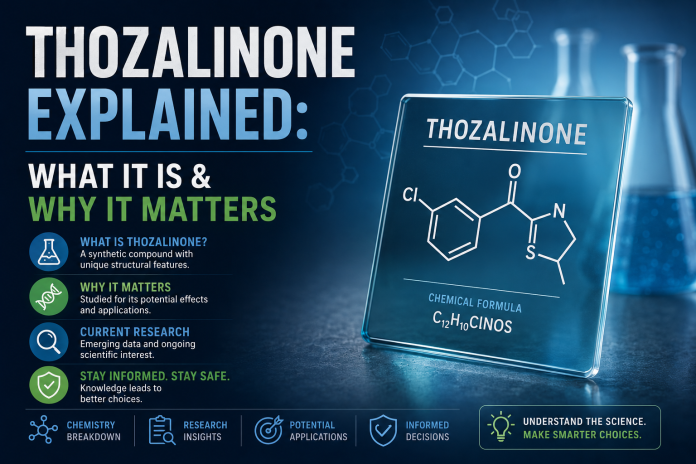
Thozalinone is a man-made stimulant drug. It makes your brain release more dopamine, a chemical related to mood and motivation. In the past, it was tested as an antidepressant and an appetite suppressant. It’s not used by doctors anymore.
Here’s what you need to know:
| Detail | Information |
| Other Names | Stimsen, CL-39808, Tozalinone |
| Drug Class | Dopaminergic Stimulant, Psychostimulant |
| Former Medical Use | Antidepressant, Appetite Suppressant |
| Typical Half-Life | About 4–6 hours |
| Structural Family | Oxazolidinone derivative |
How Thozalinone Works in the Brain
Dopamine & Norepinephrine: What It Does
Thozalinone tells certain brain cells to release more dopamine. It also slightly increases norepinephrine. If you want to look into the technical research, there’s info from the University of Minnesota program.
This drug works by making your brain release more of these chemicals, not by blocking how they’re cleared away. That’s different from how most antidepressants work.
When dopamine goes up, people often feel better, more awake, and sometimes less hungry. It doesn’t really do much with serotonin.
Thozalinone vs. Classic Stimulants
| Feature | Thozalinone (old studies) | Amphetamine |
| Main Action | Boosts dopamine release | Causes release and blocks reuptake |
| Appetite Suppression | Known to last longer | Strong, shorter-lasting |
| Heart Side Effects | Lower risk | Can raise heart rate, blood pressure |
| Abuse Risk | Lower | Higher |
Old animal and human studies showed it lowered appetite well, didn’t affect the heart as much, and wasn’t as addictive as amphetamines.
Those looking to buy Thozalinone online can find it listed on Express Highs.
Past Medical Uses: Antidepressant, Weight Loss, and More
Doctors used Thozalinone for a while.
As an Antidepressant
It was sold in Europe as Stimsen.
One of the important studies happened in 1966: A double-blind, placebo-controlled trial by Gallant and others. They tested Thozalinone on people with depression, but the details about how many people and who they were aren’t clear. Some sources say around 120 people took part, but this isn’t confirmed.
Doses were from 50 to 150 mg per day. Improvements in mood were measured using standard depression scales. People on Thozalinone did better than those on placebo. Some smaller European studies reported about 65% of hard-to-treat patients felt better, though details are limited.
Side effects? The most common were trouble sleeping, dry mouth, and feeling jittery.
The main mood boost comes from more dopamine. It seemed to cause fewer side effects than older medicines.
For Weight Loss and Parkinson’s
Animal studies showed it worked well for appetite control, sometimes better than amphetamine. Some thought it might help in Parkinson’s due to the dopamine effect, but it wasn’t adopted.
Doctors stopped using it because there isn’t enough modern evidence or safety data.
Effects: What Was Noticed
Good Effects at Usual Doses
From old research, users felt:
- Happier and more interested in things
- More physical and mental energy
- Less hungry
- More motivated and focused
Again, this is based on small, older studies.
Common Side Effects and Safety
Typical issues included:
- Trouble sleeping
- Feeling jittery or restless
- Dry mouth
It didn’t seem to cause many heart problems or blood pressure increases. High doses in animals didn’t lead to seizures.
But there’s a limitation: There’s only data for short periods. No studies longer than two months. We don’t know about effects on the heart, liver, kidneys or nerves if used long-term.
Why Thozalinone Isn’t Used Now
Missing Evidence
It hasn’t been tested in:
- Large groups of people
- For long-term safety
- To find rare side effects
Regulators want stronger evidence. Better medications have become available.
Detailed information about how the body handles it isn’t available: Nothing about peak levels, how fast it gets into your system, or how your body clears it out. It’s probably processed by the liver and leaves through the kidneys.
Abuse and Dependence
Reports say people didn’t abuse it as much as amphetamines or pemoline. No reports of addiction or withdrawal in clinics.
No direct studies compare its addictive potential to amphetamines.
For amphetamines, the addictive potential is well-documented. Pemoline, another stimulant, had less abuse but was limited due to liver risks.
Most of what we know is from old records, not the modern tests used for today’s medications.
Thozalinone’s Legal Status
Is It Legal?
It’s mostly not controlled. It’s in a gray area. Not approved as a medicine anywhere.
| Region | Typical Status |
| US | Unscheduled, only sold as a research chemical |
| EU / Europe | Not approved; could be covered by new substance rules |
| Canada | No specific laws |
| UK | Not scheduled |
| Australia | Not scheduled |
| Japan | No restrictions |
| China | Not listed |
| Brazil | Not scheduled |
| India | No specific rules |
| Worldwide | Usually unscheduled, research use only |
It isn’t a narcotic and doesn’t fall under international cocaine/heroin rules. No research chemical bans at this time.
If it’s sold for human use, that’s a different situation. Laws can change.
Why “Research Chemical” Isn’t Safe
Anything labeled “for research use” is not meant for people. No one checks how pure it is or what’s really inside. There’s a legal risk if you buy it.
If you have depression, want to lose weight, or have Parkinson’s, talk to a doctor. Don’t self-treat.
Comparing Thozalinone to Other Drugs
How It Compares
| Substance | Main Action | Approved Uses | Abuse Risk | Heart Side Effects |
| Thozalinone | Releases dopamine | Historic antidepressant | Lower | Lower |
| Amphetamine | Releases and blocks reuptake | ADHD, narcolepsy | Higher | Higher |
| Pemoline | Less powerful dopamine effect | ADHD (not used now) | Lower than amphetamine | Liver problems, heart risk |
It looked safer in some ways. Today’s drugs have more safety data.
Compared to Modern Antidepressants
We don’t know if it works better or worse than things like Prozac or Wellbutrin. New medications are much better studied.
Buying Thozalinone: What to Know
Where People Buy It
Some companies sell it as a powder, labeled “not for human use”. It usually goes for tens of dollars per gram.
Just the facts , not a suggestion to buy.
Sold as a Research Chemical
Some niche sites list it. For example, some mention it might be at sites like ExpressHighs.
But: it’s not an approved medicine. It might be risky or poor quality. Check your local laws. Don’t use it to treat health problems.
Key Takeaways
- Dopamine-releasing stimulant, once tried as an antidepressant and for weight loss.
- Older studies say it’s effective with fewer heart risks than some other stimulants.
- No big or long-term studies have been done.
- Legal gray zone , available as a research chemical, not scheduled in most places.
- For health issues, talk to a doctor.
Frequently Asked Questions
1. How fast does Thozalinone work?
Animal data suggests it starts in about an hour, peaks after 1 to 2 hours.
2. Is Thozalinone an amphetamine?
No. It’s a different kind of chemical that releases dopamine.
3. Why isn’t it used as a medicine today?
We don’t have big or long-term studies. Newer medicines have stronger evidence.
4. Is it legal to buy Thozalinone?
In many places, it isn’t scheduled but isn’t approved as a medicine. It’s in a legal gray area. Check your local rules.
5. What do we know about how the body handles Thozalinone?
Not much , no detailed data. It probably goes through the liver and kidneys.
6. Is it safe long-term?
No one knows. No studies have looked at its safety beyond 8 weeks.
Disclaimer
The information provided in this article is intended for informational purposes only and does not constitute medical, legal, pharmaceutical, or professional advice of any kind. Express Highs makes no representations or warranties regarding the accuracy, completeness, or suitability of the content for any particular purpose. Readers should not rely on this content as a substitute for advice from a qualified medical professional, legal counsel, or other relevant expert.
The products and substances discussed on this blog may be subject to varying legal restrictions depending on your country, region, or jurisdiction. It is the sole responsibility of the reader to be aware of and comply with all applicable local, national, and European Union laws and regulations before purchasing, possessing, or using any product referenced herein. Express Highs accepts no liability for any consequences arising from actions taken based on the content of this article.
This blog is intended for adults only. By reading this content, you confirm that you are of legal age in your jurisdiction.
Nothing in this article is intended to diagnose, treat, cure, or prevent any disease or medical condition. Any health-related claims discussed are not evaluated by the European Food Safety Authority (EFSA) or any other regulatory body unless explicitly stated.
Express Highs reserves the right to update or remove content at any time without notice. All content is published in good faith and for general informational purposes only.


