

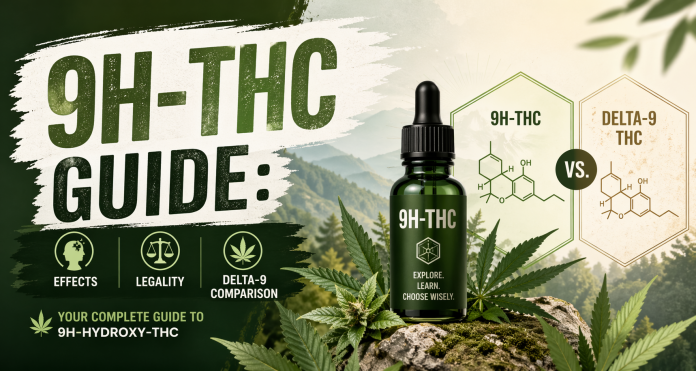
You may have noticed “9H-THC” somewhere, perhaps on a gummy jar or through a web search, and you now wonder: What is it really? Is it just Delta-9? Can you get in legal trouble for having it? Will it show up on a drug test?
Most labels won’t tell you much.
Here is the summary:
There is no reliable evidence that “9H-THC” is a real, separate cannabinoid.
It is usually just a confusing label, a typo, or a marketing term for something else. Most often, it is either Delta-9 THC or HHC (hexahydrocannabinol). This guide outlines the facts, what these labels actually mean, the legal and safety angles, and how to check what is in your product.
What Is 9H-THC? Is It a Real Thing?
Nobody has proven “9H-THC” is its own cannabinoid.
If you search for chemical information, you will find nothing.
What typically occurs:
You likely receive a product that is either Delta-9 THC, HHC, or something similar. The “9H-THC” label means nothing without the lab results, specifically the Certificate of Analysis (COA).
Here is what to check if you see a “9H-THC” label:
- View the COA. Look for names like Δ9-THC, HHC, Δ8-THC, THCA, and total THC.
- Match the batch number. It should match your product.
- If you cannot find clear information about the active cannabinoid, consider the product high risk and do not use it.
Keep in mind:
- No solid proof that “9H-THC” is its own thing.
- Most people refer to Delta-9 THC or HHC when they ask about it.
- Only the COA can determine the contents of the product.
9H-THC vs Delta-9 THC: What’s the Real Difference?
Most people simply want to know: Are they the same? Is one stronger? Which one produces a high?
Check the COA.
If it says Δ9-THC, you are getting Delta-9 effects and the same risks.
What a company calls it on their website does not matter, the COA is what matters.
| Feature | “9H-THC” (on the label) | Δ9-THC (confirmed on COA) |
| Clear chemical identity | No | Yes |
| Evidence base | None | Strong |
| Expected effects | Unknown | Psychoactive |
| Drug test risk | Unknown, probably high | High |
| Legal risk | High if synthetic | Changes by THC percent |
| Synthetic concern | Probably | Not if plant-based |
| What to look for | Exact cannabinoid name/mg | Δ9-THC mg by serving, total THC |
Much of the “9H-THC” discussion actually refers to HHC. This is important.
The Details: Delta-9 THC
Delta-9 THC is the main compound that produces a high from cannabis.
- Formula: C₂₁H₃₀O₂
- Name: (-)-(6aR,10aR)-6,6,9-trimethyl-3-pentyl-6a,7,8,10a-tetrahydro-6H-benzo[c]chromen-1-ol
It has a specific double bond that other cannabinoids do not.
Sometimes “9H-THC” Really Means HHC: What’s That?
HHC (hexahydrocannabinol) appears when THC’s double bond is replaced with extra hydrogen.
This makes it chemically stable, but changes its effects on the body.
How HHC Is Different
HHC’s formula: C₂₁H₃₂O₂
It has the same core as Delta-9, but with extra hydrogen.
HHC also comes in two shapes, called isomers: 9R-HHC and 9S-HHC.
Same basic formula, but different 3D shapes.
These shapes affect how strong the effects are.
| Isomer | CB1 Binding (tightness) | Activation (potency) | Effect strength |
| 9R-HHC | ~15 nM | ~3.4 nM | Close to Delta-9 |
| 9S-HHC | ~176 nM | ~57 nM | Weaker |
Lower numbers mean stronger binding.
Most HHC in stores is a mixture of these two isomers.
If there is more 9R, effects will be stronger, but few companies tell you the ratio.
How Labs Tell Them Apart
To know for certain if it is Delta-9 or HHC, labs use equipment like:
- Gas Chromatography-Mass Spectrometry (GC-MS/MS): Separates and identifies compounds. Works for most cannabinoids, especially if prepared correctly. Can spot 9R vs 9S HHC.
- Liquid Chromatography-Mass Spectrometry (LC-MS/MS): Good for compounds that cannot be heated. Can have difficulty separating some isomers, but can be adjusted to work better.
- High-Performance Liquid Chromatography (HPLC): Used more for preparing pure sample compounds, but still useful for testing.
Only lab tests can tell you what is really in the gummy or oil.
Product names on the front do not mean anything by themselves.
Effects: What Can You Expect?
Delta-9 THC
Typical effects:
- Relaxation, happiness
- Senses might feel different (time seems slower)
- You might feel hungry
- You could feel sleepy, especially with higher doses
Guide for using (edibles):
| Dose | What to expect |
| Low (1–5 mg) | Light relaxation, little mood boost |
| Medium (5–15 mg) | Noticeable high, stronger if you are new |
| High (15 mg+) | Strong, intense high; might make you anxious |
Proceed slowly and start small until you know how it affects you.
HHC Effects
Most who try HHC describe effects similar to Delta-9: relaxation, mood change, hunger.
But the experience is much less predictable. It depends on the amount of each isomer in the product, which you often will not know.
Timing: When It Starts, How Long It Lasts
| Product | Starts in | Lasts for |
| Vape | 5–15 min | 1–3 hours |
| Edible | 30–120 min | 4–8 hours |
| Tincture | 15–45 min | 2–6 hours |
| Drink | 15–60 min | Varies |
These are only estimates.
Side Effects, Safety, and Dosing Mistakes
What to watch for:
- Dry mouth
- Red eyes
- Anxiety (especially with high doses)
- Fast heart rate
- Dizziness or stomach upset
- Feeling sluggish the next day, especially after edibles
- Do not drive afterward
How to stay safer:
- Start at a low dose, and be patient.
- Do not mix with alcohol.
- Only use products with recent, real COAs that match your batch.
- Keep out of reach of children and pets.
- If you experience chest pain or fainting, stop and get medical help.
Ask your doctor if you have health concerns. This is not medical advice.
Drug Tests: Will You Test Positive?
Expect it.
If your product contains Delta-9 THC, regular drug screens will detect it.
The test looks for a breakdown product (THC-COOH) that remains after the effects wear off.
HHC results are less certain.
It might not trigger every THC test, but it could. The technology is always improving, so there is no way to be sure.
How Tests Work
- Urine: Most common. Looks for THC-COOH. Can pick up use from a day to weeks ago, depending on how often you use it.
- Blood: Sees both the active drug and its breakdowns. Suitable for recent use, but not used as frequently.
- Hair: Shows use over about three months. Difficult to determine exactly when use occurred.
HHC and Tests
Because HHC looks similar to THC, it can sometimes cause “false” positives on tests. Some may pass the urine test but get flagged on the initial screen and then not be confirmed later in follow-up testing.
If you are worried about a drug test, avoid these products.
Legality: Federal Rules, Upcoming Changes, and State Laws
Federal Basics
The 2018 Farm Bill allows hemp and hemp products with 0.3% or less Delta-9 THC (by dry weight).
Most hemp cannabinoids from natural plants are covered, but not synthetic versions.
The DEA states synthetic tetrahydrocannabinols are controlled substances regardless of the source.
The Synthetic Question
Most commercial HHC is made by converting Delta-9 or Delta-8 into HHC in a lab.
Federal law and DEA guidance state synthetically made THC products are not covered by the Farm Bill, meaning they are illegal federally. Court rulings have made this complex; some judges say certain products might be legal if they start with plant material and have low enough Delta-9.
Bottom line: If it is synthetic, it is probably illegal under federal law.
What’s Coming in 2026
| Date | Rule |
| Until Nov 11, 2026 | Hemp can have up to 0.3% Delta-9 THC by dry weight |
| As of Nov 12, 2026 | Total THC capped at 0.3% dry weight, synthetic cannabinoids banned, consumer packages limited to 0.4 mg THC per container |
Laws may continue to change.
Your State May Already Ban It
- Some states ban all “intoxicating” hemp cannabinoids, or any synthetic ones.
- Some have specific rules for cannabinoids like HHC (examples: California, Oregon, Texas, New York, and others).
- Testing and enforcement can vary.
- What is on the package and what is in the bottle are not always the same.
Check your exact state rules before you buy or use these products. This is not legal advice, look up your own area’s rules.
How to Shop More Safely: What to Look for in a COA
Product Types
- Edibles (including gummies)
- Vapes
- Tinctures
- Drinks
Quick COA Checklist
- Batch/lot numbers on package and COA match.
- The lab is accredited (ISO/IEC 17025 or a state license).
- The COA lists specific cannabinoid types and the dose per serving.
- You see a complete cannabinoid panel, not just a single number.
- PASS or ND (not detected) for substances like pesticides and solvents.
- Recent test date (preferably less than a year old).
- Avoid products with questionable or vague COAs.
Quick COA Scan
| What | What to notice |
| Lab name and credentials | ISO accreditation or state license number |
| Product/batch info | Make sure it matches your product |
| Date | Should be fresh (last year) |
| Cannabinoid breakdown | Which cannabinoids, and how much per serving |
| Contaminant results | PASS or ND on all tests |
A good safety rule: aim for 8 mg or less THC per serving (not the law everywhere, but a solid guideline).
How to Read a COA
Imagine you have a “9H-THC” gummy and its COA.
What should you do?
- Check product and batch: The info should match up, read the product name and batch/lot number.
- Look for lab credibility: Is the lab certified? Is there an authentic signature?
- Review potency: Find the actual cannabinoids by name. How many mg per serving? Which method did the lab use?
- Check for safety: Look for PASS/ND for pesticides, metals, solvents, bacteria, and mold.
- Date: Was it tested recently?
- Final review: All categories should clearly say PASS.
If something is missing or incorrect, do not trust the product.
Delta-9 vs “9H-THC” Products: What Should You Choose?
Want predictable results?
Select a clearly labeled Delta-9 product that comes with a batch-specific COA. It is reliable.
See a product labeled “9H-THC” and feel unsure?
Do not buy unless you can see a COA that specifies the key cannabinoid, the amount per serving, and product safety.
Thinking about HHC?
Know the effects are less predictable, and legal risks are higher, especially after 2026. Pick brands that share their COA and even the 9R/9S breakdown if possible.
FAQ
Is 9H-THC the same as Delta-9 THC?
No solid evidence says “9H-THC” is its own compound. Most likely, it is a mislabel, and the product is Delta-9 or HHC. Always check the COA.
Is 9H-THC stronger than Delta-9?
There is no real data on “9H-THC.” If it is HHC with more 9R content, it can be as strong as Delta-9. Without a good COA, you cannot know.
Is 9H-THC just HHC?
Sometimes. Some people use the term for HHC. Do not assume, check the lab results.
Can 9H-THC produce a high?
If you see Delta-9 or strong HHC, probably yes. If the identity is not clear, do not trust the label for effects.
Will it fail a drug test?
Probably. Standard tests will catch Delta-9 and sometimes pick up HHC. If testing matters, do not use these.
Is it legal to buy online?
Federal law does not protect most synthetic cannabinoids, and state rules can be stricter. Laws became stricter in 2026. Always check your state laws.
What should a good COA include?
Lab name, accreditation, product and batch info, test date, full cannabinoid breakdown per serving, and safety results (PASS/ND).
Best way to try a new cannabinoid?
Start small. Wait to see how it affects you. Only use products with up-to-date, matching, and full-panel COAs. Do not mix with alcohol. Do not drive after.
Bottom Line
If your lab report says Delta-9 THC, treat it as such, expect classic effects, a good chance of a positive drug test, and the usual legal concerns.
If it is HHC, expect less predictability and more legal risk, especially after 2026.
If the product does not have a COA clearly stating the cannabinoid, the dose, and the safety tests, do not use it.
Never drive after using these products. Keep out of reach of children.
Ignore the marketing, always trust the COA.
Disclaimer
The information provided in this article is intended for informational purposes only and does not constitute medical, legal, pharmaceutical, or professional advice of any kind. Express Highs makes no representations or warranties regarding the accuracy, completeness, or suitability of the content for any particular purpose. Readers should not rely on this content as a substitute for advice from a qualified medical professional, legal counsel, or other relevant expert.
The products and substances discussed on this blog may be subject to varying legal restrictions depending on your country, region, or jurisdiction. It is the sole responsibility of the reader to be aware of and comply with all applicable local, national, and European Union laws and regulations before purchasing, possessing, or using any product referenced herein. Express Highs accepts no liability for any consequences arising from actions taken based on the content of this article.
This blog is intended for adults only. By reading this content, you confirm that you are of legal age in your jurisdiction.
Nothing in this article is intended to diagnose, treat, cure, or prevent any disease or medical condition. Any health-related claims discussed are not evaluated by the European Food Safety Authority (EFSA) or any other regulatory body unless explicitly stated.
Express Highs reserves the right to update or remove content at any time without notice. All content is published in good faith and for general informational purposes only.


