

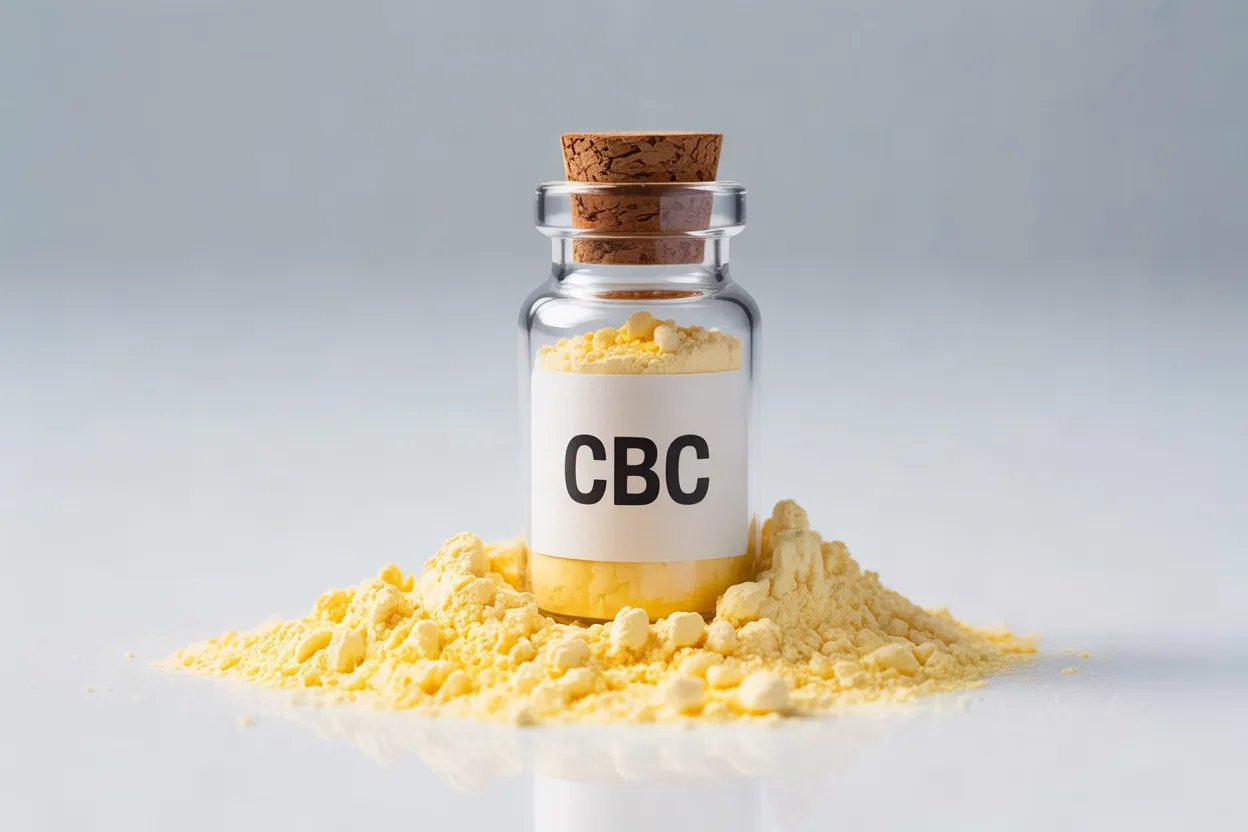
CBC is a lesser-known cannabinoid found in cannabis and hemp. This guide explains what CBC isolate contains, what research can tell us, and what to check on a product label and lab report.
Here is the short answer. CBC isolate is a highly purified, non-intoxicating cannabinoid. It does not get you high. Research is still early, and there is very little human data on benefits, side effects, or dosing. If you are buying it, quality testing matters more than marketing claims.
What Is CBC Isolate?
Cannabichromene (CBC) is a minor cannabinoid found in hemp and cannabis plants. CBC isolate is the most purified form of CBC. The goal is to remove other cannabinoids, terpenes, waxes, and plant material so the final product is almost all CBC.
A true CBC isolate should have:
- High CBC content, supported by a batch-specific assay
- Very low or non-detectable THC
- A lab report for the exact batch
- A clearly described physical form and ingredient list
CBC isolate is a specialist cannabinoid ingredient. For an introduction to the compound and the limits of current research, read the Express Highs guide to CBC.
Does CBC Isolate Get You High?
No. CBC isolate should not get you high.
The cannabis “high” is mainly tied to THC and its action at CB1 receptors in the brain. CBC does not have the same effect. If a CBC isolate product makes you feel intoxicated, the most likely reasons are:
- THC contamination
- Incorrect labeling
- A mixed formula that was sold as an isolate
Effects and Possible Benefits of CBC Isolate
Most CBC research is still at the lab or animal stage. That means the effects below are possible, not proven in humans.
Area studied | What early research suggests | What is still unknown |
|---|---|---|
Pain pathways | CBC may affect channels tied to discomfort signaling | Whether it helps people with pain |
Inflammation | CBC may influence inflammatory responses | If this leads to useful results in humans |
Skin use | CBC is used in some topical products | Whether it helps specific skin conditions |
Mood and nerves | CBC has been studied for nerve and brain-related activity | Human results and safe dosing |
Possible Uses
CBC isolate is sometimes used in:
- Tinctures and oils
- Topicals like balms and lotions
- Capsules or softgels
- Edibles
- Product blending, where CBC is added to other cannabinoid formulas
CBC Isolate Side Effects
Human safety data is limited, so side effects are not fully known. Still, possible issues include:
- Drowsiness
- Dry mouth
- Stomach upset
- Dizziness
- Unexpected sedation when mixed with other substances
Be extra careful if you use alcohol, opioids, sleep aids, benzodiazepines, or sedating allergy medicine.
Drug Interactions: What to Watch For
CBC’s potential drug interactions are not well established in humans. Laboratory findings about cannabinoid metabolism cannot reliably predict the effect of combining CBC with a particular prescription medicine.
Ask a pharmacist or clinician to review your medicines, especially sedatives or medicines that require close monitoring. Do not assume that an interaction documented for CBD or THC also has the same strength or mechanism with CBC.
If you take prescription medicine, ask a clinician before using CBC.
Dosage: Is There a Standard Amount?
There is no standard clinical dose for CBC isolate.
Human studies involving mixtures of cannabinoids do not establish a safe or effective dose for CBC isolate alone. A suggested serving on a product label is not a clinically validated dose.
Before considering use:
- Check whether the product is intended for consumer use
- Discuss suitability and dosing with a qualified clinician
- Avoid mixing with alcohol or other sedating products
- Do not use it as a replacement for medical care
How to Check CBC Isolate Quality
Do not rely on claims like “99% pure” unless the batch report supports them. Look for an independent laboratory accredited to ISO/IEC 17025 for the relevant tests, and check more than potency.
What a COA Should Show
The report should identify the batch, laboratory, test methods, cannabinoid content, and THC results. It should also include relevant testing for solvents, heavy metals, pesticides, and microbial contamination.
Contaminant limits depend on the jurisdiction, product type, and route of use. A generic list of ppm limits is not enough to establish that a particular product is compliant or safe.
How CBC Isolate Is Made
Getting CBC to very high purity takes more than a basic extraction. A 99% isolate usually needs several steps.
Common production process
- Supercritical CO₂ extraction
- This is a common first step for pulling cannabinoids from plant material.
- Extraction conditions vary with the equipment and intended product.
- Some processes use ethanol as a co-solvent. The exact method should be documented by the manufacturer.
- Crude refinement
- The raw extract can contain CBC, CBD, THC, and terpenes.
- Reversed-phase flash chromatography
- This helps separate CBC from other minor cannabinoids.
- Preparative HPLC
- This is often used as a final polishing step to reach very high purity, including 99%+ isolate grades.
CBC Formulation: Why Product Instructions Matter
CBC may be used in oil-based formulations, but a home mixing ratio does not establish a safe dose or a stable finished product. Use only material intended for the stated application, and do not assume that a clear mixture has been tested for uniformity or safety. When comparing CBC isolate with CBD oils and cannabinoid blends, check the ingredient list and batch report: an oil’s format alone does not tell you whether it contains CBC.
Check the manufacturer’s instructions and ask a qualified professional about suitability before use. An isolate sold for research is not automatically suitable for ingestion or inhalation.
CBC Isolate vs Broad-Spectrum and Full-Spectrum Products
Product type | What it contains | THC content | Best for |
|---|---|---|---|
CBC isolate | Mostly CBC only | Usually non-detectable or very low | People who want a single cannabinoid |
Broad-spectrum | Several cannabinoids, but usually no THC | THC removed or minimized | People who want more plant compounds without THC |
Full-spectrum | More of the plant’s natural mix | May contain THC | People okay with possible THC exposure |
Is CBC Isolate Legal?
CBC’s legal status depends on the country or state, how it was produced, its THC content, and the intended use of the finished product. A hemp designation does not automatically authorize food, supplement, cosmetic, or vape sales.
Check current local regulations and import rules before ordering. A seller’s willingness to ship is not proof that possession or use is permitted at the destination.
Frequently Asked Questions About CBC Isolate
What does CBC do compared to CBD?
CBD has been studied much more in humans. CBC is still early-stage. They are not directly comparable, and there is no solid proof that one is better than the other.
Does CBC give you energy?
There is no strong evidence that CBC boosts energy. Some people may even feel drowsy.
Is a 99% CBC isolate really pure?
It can be close, but only a batch-specific COA can confirm it. Look for the exact CBC percentage and contaminant testing.
Should you use CBC isolate in a vape?
Do not assume CBC isolate is safe to inhale. A product’s availability or purity claim does not establish inhalation safety, and products should never be used outside their stated intended use.
Final Verdict: Who Should Consider CBC Isolate?
CBC isolate may be worth a look if you:
- Want a non-intoxicating cannabinoid
- Need low or no THC
- Are comfortable with early-stage research
- Check lab reports before buying
- Understand that human proof of benefit is limited
CBC isolate is interesting, but it is not a proven health product. The biggest issues are purity, legal status, drug interactions, and realistic expectations.
Disclaimer
The information provided in this article is intended for informational purposes only and does not constitute medical, legal, pharmaceutical, or professional advice of any kind. Express Highs makes no representations or warranties regarding the accuracy, completeness, or suitability of the content for any particular purpose. Readers should not rely on this content as a substitute for advice from a qualified medical professional, legal counsel, or other relevant expert.
The products and substances discussed on this blog may be subject to varying legal restrictions depending on your country, region, or jurisdiction. It is the sole responsibility of the reader to be aware of and comply with all applicable local, national, and European Union laws and regulations before purchasing, possessing, or using any product referenced herein. Express Highs accepts no liability for any consequences arising from actions taken based on the content of this article.
This blog is intended for adults only. By reading this content, you confirm that you are of legal age in your jurisdiction.
Nothing in this article is intended to diagnose, treat, cure, or prevent any disease or medical condition. Any health-related claims discussed are not evaluated by the European Food Safety Authority (EFSA) or any other regulatory body unless explicitly stated.
Express Highs reserves the right to update or remove content at any time without notice. All content is published in good faith and for general informational purposes only.

